
A Table of Grace
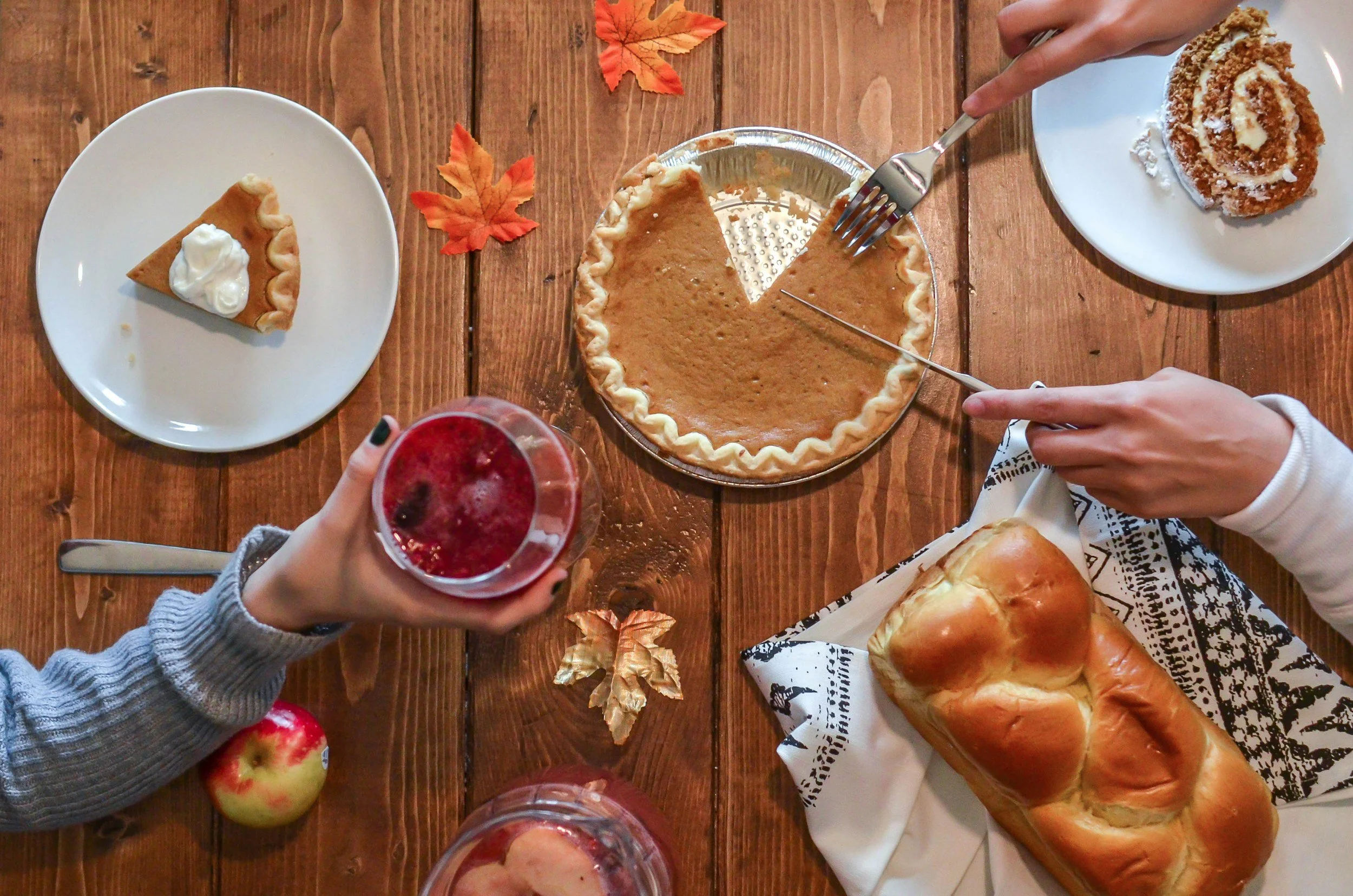
I’ve always wondered why there aren’t as many Thanksgiving-themed cultural artifacts as there are Christmas ones. For every ten Christmas movies, there’s maybe one entry remotely concerned with Thanksgiving. I haven’t fact-checked that ratio, but it sounds right. Perhaps there is a treasure trove of Hallmark films I haven’t explored that someone can introduce me to, but the point remains that Thanksgiving doesn’t have the same commercial appeal as the one involving a saint from the North Pole riding around in a reindeer-led sleigh, delivering presents to every good little girl and boy. That’s not what Christmas is about, of course, but the cultural and ecclesiastical liturgies revolving around the Yuletide season can’t hold a candle to the gospel-infused ceremony known as Thanksgiving.
I’m not saying that just because I’m a Baptist who loves potlucks. (What Baptist doesn’t, though?) I’m saying that because of all the holidays that may or may not be derived from Scripture, Thanksgiving is the one that can very well be pulled from the Bible’s pages and deployed into everyday life. Without digressing into the varied histories and legends surrounding such holidays as Halloween and Christmas, and whether or not Christians should celebrate them (that’s a different article), Thanksgiving’s origins are uniquely rooted in fidelity to the Word and to God himself, whose grace abounds in all seasons. As the apostle Paul testifies, whether in plenty or in want, the remarkable claim Christianity makes is that we can be grateful and content (Phil. 4:11–12). This was demonstrated exceptionally well during that first Thanksgiving feast in 1621.
In ways entirely dissimilar to our modern sense of ease when approaching the fourth Thursday of November, the original feast of thanks emerged out of severe exhaustion and hardship. After landing in Plymouth, the Pilgrims experienced a particularly pointed season of grief, suffering, and loss, with approximately half of their company of men, women, and children dying from scurvy or some other illness. William Bradford, an English Separatist and eventual governor of the Plymouth Colony, and one of the original signers of the Mayflower Compact, would later refer to this season as the most sad and lamentable stretches that befell those who had ventured to the new world (Davis, 108). Of the “100. and odd persons” who landed in Plymouth, Bradford recalls, “scarce 50. remained” (Davis, 108). Much of the labor during those initial months involved mere survival, even as they did what they could to care for the dying.
Circumstances were somewhat different, though, come the autumn of 1621. According to a letter written by Edward Winslow, an account is given that four of the surviving English settlers were dispatched to go “fowling,” returning with “as much fowl as served the company almost a week” in only one day’s time. With the “fruits of their labors” successfully gathered, Winslow relays how ninety men from the Wampanoag, along with their king, Massasoit, convened, entertained, and feasted with the Pilgrims “for three days.” A few of the Wampanoag even “went out and killed five deer, which they brought to the plantation and bestowed on our Governor and upon the Captain and others” (Hanks, 82). This three-day celebration, along with all its trappings of fellowship, community, and hunting, is regarded as the first Thanksgiving meal. That simple harvest feast, freighted with such desperation and death as it was, is a testament to God’s storehouses of grace and mercy, which he dispenses on the weary.
This, to be sure, isn’t an anachronistic rendering of those events through theologically-biased eyes. Rather, this is how those who were there understood what was unfolding before them. It wasn’t merely that good fortune had materialized; it was God’s hand sustaining them. All things pointed to divine provision manifest in their midst, from the abundance of fowl, fish, venison, and corn that they enjoyed to their recovery of “health and strength,” which, as Bradford recalls, “put as it were new life into them.” Through it all, “it was the Lord,” he continues, “which upheld them, and had beforehand prepared them” (Davis, 114). They had been carried through searing difficulty and great loss, only to be led into “green pastures,” where a table of goodness and mercy had already been prepared for them (Ps. 23:1–6). Every Thanksgiving, therefore, is meant not only to pay tribute to the unlikely grace that was so clearly on display four centuries ago, but also to commemorate the God who was behind it all, and still is.
When describing what it means and what it looks like to walk after the Lord after having “received Christ Jesus the Lord,” by faith, Paul tells the Colossians that the hallmark of faith that is “rooted and built up” in Christ is one that is “abounding in thanksgiving” (Col. 2:6–7). With the infinitely unfathomable work of Christ in view, the life of the Christian becomes one marked by thanksgiving and gratitude, not once a year, but continually. “Whatever you do,” Paul says later on, “in word or deed, do everything in the name of the Lord Jesus, giving thanks to God the Father through him” (Col. 3:17). In that way, Thanksgiving reflects the Christian faith more clearly than most other holidays. Its liturgy, which is rooted in God’s provision, imbues us with a sense of gratitude that’s downstream of the bountiful grace of God, which was put on display in Christ, who gave himself for them. This is true of God’s people, notwithstanding their historical moment or geographical context.
The encroachment of commercialization around the holidays can be felt in rural communities just as much as anywhere else, with every Walmart hastening to stow away the ghouls, goblins, and jack-o’-lanterns to make way for an array of tinsel, garland, and Santa Clauses before the first leaf has fallen. Even in places where there’s only one stoplight, the holiday marketing machine keeps churning, regulating everyone’s calendar. The fourth Thursday in November, then, is a holy opportunity, especially for rural pastors in regions where life is still largely run by seasons and soil, to demonstrate that there’s something deeper at work during that brief interlude between Halloween and Christmas. It’s an invitation to remember that everything is a gift “from above” (James 1:17), from the rains to the harvest to good health to the community that surrounds us.
Thanksgiving is more than a seasonal ceremony confined to the calendar; it’s a witness to the ways in which God supplies all of our needs “according to his riches in glory in Christ Jesus” (Phil. 4:19). Instead of merely an annual thing that’s accompanied by turkey, football, and pumpkin pie, Thanksgiving is what happens when God’s weary Pilgrims, both then and now, take heart and pull up a chair at the table God has prepared for them.
Bibliography:
William T. Davis, editor, Bradford’s History of Plymouth Plantation, 1606-1646 (New York: Charles Scribner’s Sons, 1908).
Charles Stedman Hanks, Our Plymouth Forefathers: The Real Founders of Our Republic (Boston: Authors’ Publishing Association, 1907).

Bradley Gray
Bradley serves as the senior pastor of Stonington Baptist Church in Paxinos, Pennsylvania, where he lives with his wife Natalie and their three children, Lydia, Braxton, and Bailey. He is the author of Finding God in the Darkness: Hopeful Reflections from the Pits of Depression, Despair, and Disappointment and is a regular contributor for 1517 and Mockingbird. He also blogs regularly at www.graceupongrace.net.
