
Three Lessons Worth More Than Green Beer
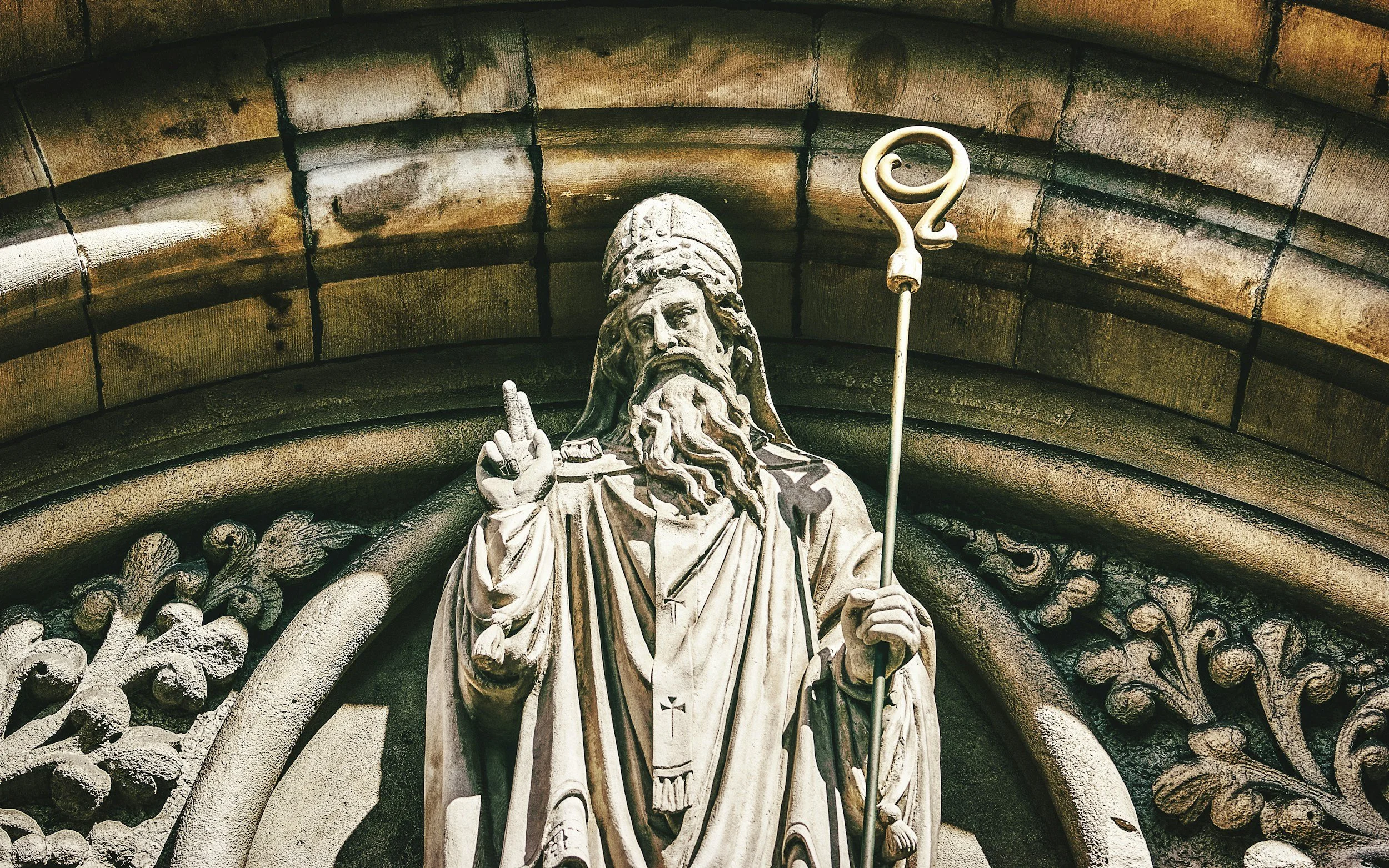
For many of us, St. Patrick’s Day is associated with green beer, Irish food, and a vague sense of luck involving leprechauns. But the day bears the name of a real person, and behind the cultural trappings stands a remarkable Christian witness whose life continues to offer the church enduring lessons.
Patricius (later known as St. Patrick) was born around 387 AD to an aristocratic family in Briton. He was baptized, raised within the Christian faith, and instructed in the catechism. By his own admission, however, Patrick was a nominal believer in his youth, indifferent to God and dismissive of the pastors of his day.
That changed abruptly when, at the age of sixteen, Patrick was captured during a raid by Celtic pirates and sold into slavery in Ireland. According to his autobiographical Confession, Patrick was put to work herding livestock, likely for a druid household. His days alternated between isolation in the fields and life among other enslaved Britons, some of whom were probably Christians.
Patrick describes this period as one of profound spiritual transformation. Alone with the rhythms of creation — the seasons, the winds, the stars — he became deeply aware of the God he had once ignored. In his own words: “After I had arrived in Ireland, I found myself pasturing flocks daily, and I prayed a number of times each day. More and more the love and fear of God came to me, and faith grew . . . until I was praying up to a hundred times a day and in the night nearly as often.”
Patrick’s writings suggest that his growing devotion did not go unnoticed. During these years, two additional changes occurred. First, he learned the language and culture of the Irish Celts, knowledge that only an insider could acquire. Second, and more remarkably, he developed a genuine love for the very people who held him captive, longing for their reconciliation with the God he had come to know so intimately.
After six years, Patrick escaped slavery. In the Confession, he attributes his escape to divine guidance, describing a dream in which he was told that a ship was ready for him. Whether one understands this as a visionary experience or as Patrick’s theological interpretation of providential circumstances, the result was clear: Patrick journeyed to the coast, secured passage, and eventually made his way back to Briton.
The next chapter of Patrick’s life is difficult to reconstruct with precision. It appears that he spent time in Gaul, possibly within a monastic community, and later trained for ordained ministry, most likely in Briton. During these years, he immersed himself in Scripture and the orthodox theology of the Western Church, serving faithfully as a minister.
Years later, Patrick recounts another dream, again recorded in his own writings, in which he heard what he interpreted as the voice of the Irish people calling him back. Patrick understood this experience through the lens of Scripture, likening it to the Apostle Paul’s Macedonian call in Acts 16. With the affirmation of church leaders, Patrick was ordained as a bishop and sent as a missionary to Ireland around 432 AD.
Patrick did not go alone. He brought with him an “apostolic team” who shared a common life and mission. At the time, many in the broader church considered the Irish Celts unreachable due to their reputation for violence and their participation in pagan rituals, including human sacrifice. Yet Patrick’s approach was neither coercive nor contemptuous. He respected Irish language and culture where possible, engaged tribal communities and their kings, invited outsiders into Christian fellowship, and bore witness with both gentleness and courage.
The result was a remarkable movement of gospel renewal whose legacy endures to this day.
Three Lessons from the Life of St. Patrick
1. God uses our pain. Patrick’s enslavement was undeniably traumatic. Torn from his home, family, and social standing, he suffered profoundly. God was not the author of this evil, yet Patrick’s own testimony reminds us that God can redeem even our deepest wounds. In the isolation of suffering, Patrick was awakened to a living faith. As the Apostle Peter writes, “You have been grieved by various trials, so that the tested genuineness of your faith — more precious than gold that perishes though it is tested by fire — may be found to result in praise and glory and honor” (1 Pet. 1:6-7). Patrick’s story assures those isolated from family and friends that even the loneliest suffering is never wasted in the hands of a faithful God.
2. Bless those who curse you. Years after his escape, Patrick returned to the very people who had enslaved him, though not with vengeance but with the gospel. This costly obedience embodies the grace of Christ, who calls those comforted by mercy to extend that same mercy to others. Patrick’s life gives flesh to Peter’s exhortation: “Do not repay evil for evil… but on the contrary, bless” (1 Pet. 3:9). Such forgiveness is not natural; it is the fruit of a heart redeemed by Christ’s forgiveness and transformed by the sanctifying work of the Holy Spirit (Matt. 7:41-50). Patrick’s witness speaks to rural pastors who love, serve, and forgive the same people year after year, trusting God to work through patient, costly faithfulness.
3. The gospel flourishes in community. Patrick’s missionary strategy was deeply communal. He recognized the strong tribal bonds of Celtic society and mirrored them within his apostolic teams and emerging Christian communities. Patrick understood that faith is not sustained in isolation. Scripture affirms this wisdom: “Two are better than one . . . For if they fall, one will lift up his fellow” (Eccl. 4:9-10). The church, then and now, bears witness most faithfully when it lives as a visible, supportive community (Eph. 4:1-6). Patrick’s model resonates with rural churches, where ministry happens through shared meals, long memories, and lives woven closely together.
Patrick’s story resonates deeply with rural churches and communities. His faith was forged in quiet places: fields, hillsides, long nights under open skies. He ministered far from centers of power, among people often dismissed as unimportant or unreachable. Rural pastors and congregations may recognize something familiar here.
Patrick reminds us that God does not overlook the margins. He works powerfully through small communities, shared life, patient presence, and deep trust in Christ. In places where relationships matter, where creation still speaks, and where faith is often lived quietly and faithfully, Patrick’s witness encourages us to remain steadfast. The same God who met Patrick in the fields of Ireland continues to meet his people today, calling them to faithful trust, bold love, and shared gospel witness in rural communities that matter deeply to him.

Mike Birbeck
As the Pastor of First Presbyterian Church, Wellsboro, since 2015, Mike has a passion for holistic transformation through the Gospel. Mike and his wife, Jessica, have a daughter named Priya. They enjoy travel, the outdoors, and, most of all, spending time together as a family. Mike received his Bachelor’s Degree in Biblical Studies from Cairn University and his Master’s of Divinity from Gordon-Conwell Theological Seminary. Prior to coming to First Presbyterian Church Wellsboro, he served as Pastoral Assistant at First United Presbyterian Church in Cambridge, MA, for two years and Director of Youth Ministry at First Presbyterian Church of Levittown in Levittown, PA, for eight years.
